

Stinger

Read your script off the screen without looking like you are

Stinger hangs your script right under the camera on your Mac, so your eyes stay on the lens while you say exactly what you meant to say.

Free 7-day trial · No card · Auto scrolling on one Mac. Voice and Track require a paid license. Start your trial inside the downloaded Mac app.

Person — gaze toward the headline, plain background

WHAT STINGER DOES

One app, one job

Stinger keeps your script in view and your eyes on the lens, take after take.

Under the camera

Your eyes stay on the lens, not on your notes

The script hangs right under the camera, in the notch if your MacBook has one, top-center if it doesn't. You're looking at the person watching, not down at a window, so the take reads like you talking instead of reading.

More about Under the camera

Open Stinger and read one sentence out loud in the set-up assistant. It calibrates your mic and your pace. Paste your script, press Load and finish, and it appears under the notch. Press ⌘P and a 3-2-1 countdown gives you a second to find the lens before the script lights up. Hover the panel any time to pause and see the controls: play, restart, mode, speed, and a grip to drag it wherever you need it. Run the set-up assistant again from Help whenever your mic or pace changes.

  • Notch Macs: script sits directly under the camera
  • No notch or external display: script sits top-center
  • One-sentence calibration in the set-up assistant, re-runnable any time
  • ⌘P starts a 3-2-1 countdown before the script lights up
  • Hover to pause and reach play, restart, mode, speed and drag controls
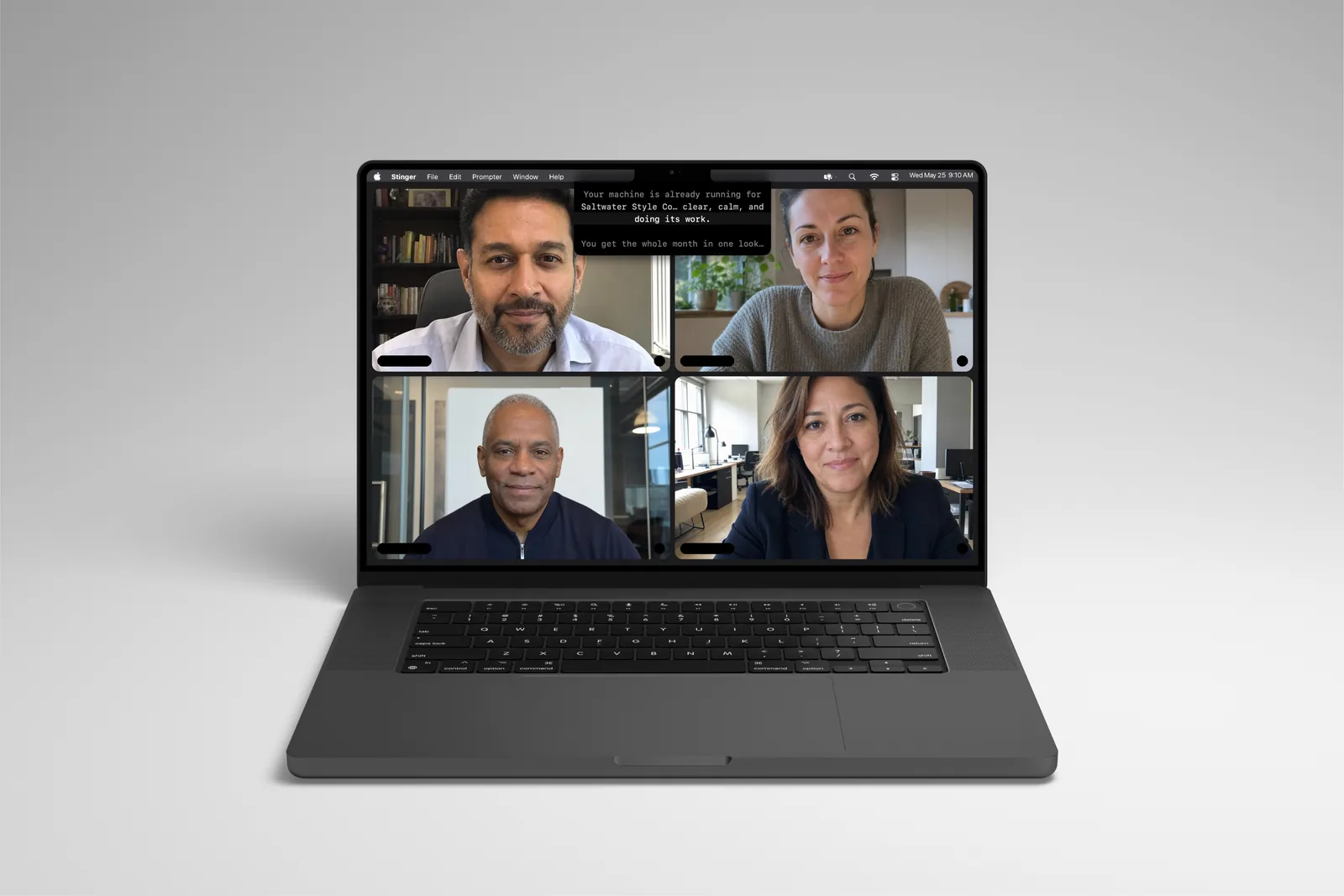
Stinger's script panel under the camera notch of a MacBook Pro during a video call
A real Stinger capture on a MacBook Pro

Auto, Voice and Track

Read at your pace, your breathing, or your actual words

Auto holds a steady speed you set. Voice moves while you're talking and pauses when you stop, going by microphone level, not what you say. Track follows the words themselves on the Mac and stays on the line you're actually saying, so ad-libbing, skipping ahead or restarting a sentence doesn't lose your place.

More about Auto, Voice and Track

Auto scrolls at a fixed lines-per-minute pace you change live with ⌘↑ / ⌘↓ or the hare and tortoise buttons. Good for a steady, polished read. Voice scrolls on microphone level: it waits about 0.15 seconds before starting and about 0.6 seconds of silence before pausing, so breaths and commas don't stop it. Track uses on-device speech recognition to keep the lit line on the words leaving your mouth; if it loses confidence for four seconds it behaves like Voice mode until it catches back up. Track needs the on-device language model for your language, listed in Settings › Voice & Track. Voice and Track come with a license; the free 7-day trial scrolls in Auto.

  • Auto: set pace, adjustable live with ⌘↑ / ⌘↓
  • Voice: scrolls on microphone level, pauses on silence — does not recognise words
  • Track: follows your actual words with on-device speech recognition
  • Track falls back to Voice-like behavior for up to four seconds if unsure
  • Voice and Track need a license; the trial runs in Auto
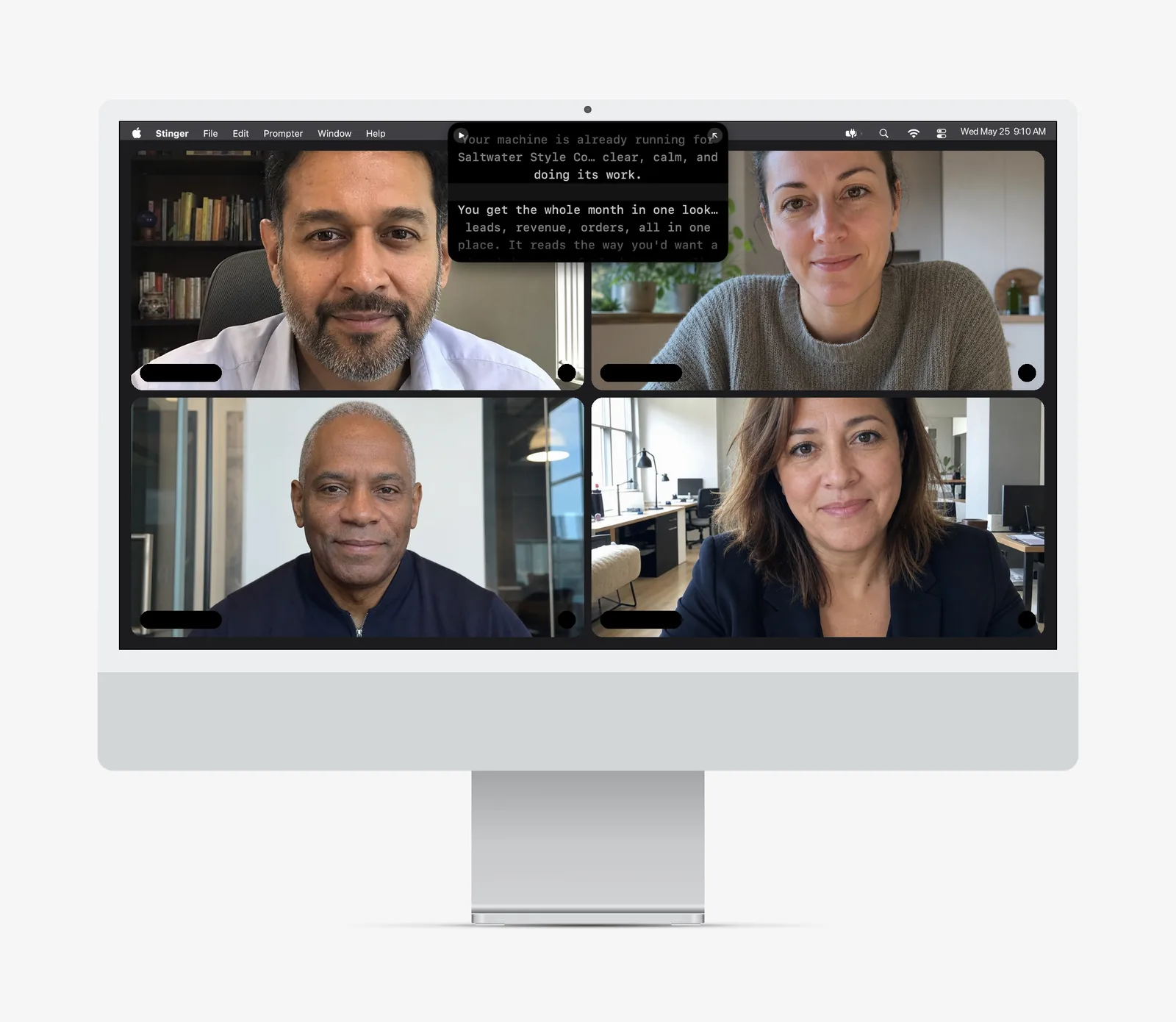
Stinger's panel at the top of an iMac screen during a call
Stinger on an iMac, where the panel sits top-centre

Ghost Check and Demo Mode

Check what your audience can see

Stinger asks macOS to exclude its panel from capture. Use Ghost Check, then verify in the meeting or recording app and sharing mode you plan to use; capture behavior varies.

More about Ghost Check and Demo Mode

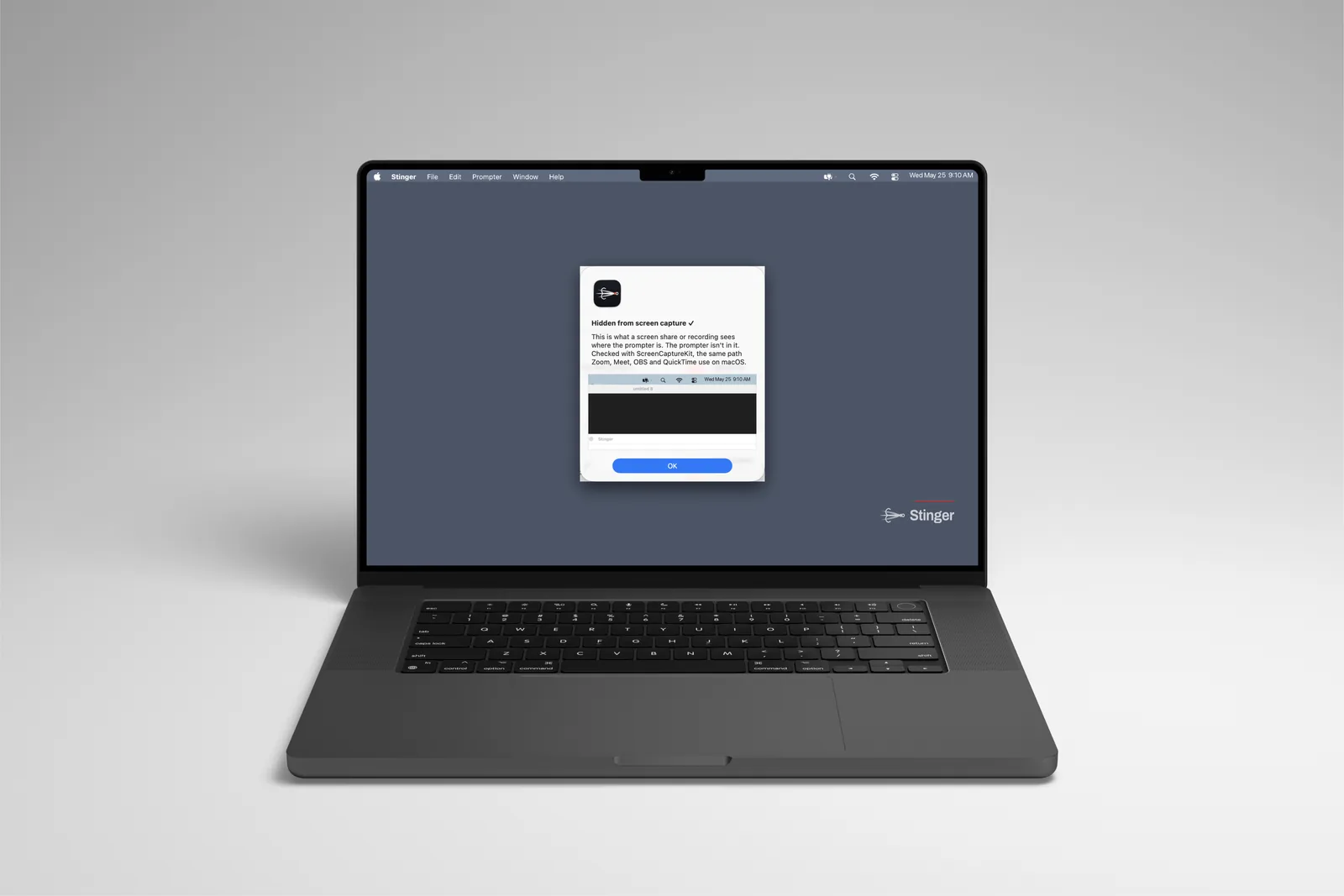
Run Ghost Check in Stinger to inspect its screen capture. Then make a short recording or inspect a second device using your actual calling app and sharing mode. One capture path does not certify another. Screen Recording permission is needed for Ghost Check. Demo Mode intentionally shows the panel for tutorials and turns off when you quit.

  • Run Ghost Check before a call
  • Check the output of the app and sharing mode you will use
  • Keep Demo Mode off for normal prompting
  • Repeat the check after changing apps, displays, or settings
Stinger's Ghost Check result on a MacBook Pro
Ghost Check, captured from the app

Rehearse and the cut list

Watch the take back, and know exactly where it went sideways

Record a take and play it back. Every take also leaves a cut list, a timestamped record of every pause, restart, re-read and section jump, so you or your editor can go straight to the moment it slipped instead of rewatching the whole thing.

More about Rehearse and the cut list

Every time you press play, Stinger starts logging: the start, any pause longer than 1.5 seconds, resumes, re-reads (backward nudges, jumps back, or Track catching you re-reading), restarts, section jumps, and the end, each with a timestamp measured from when the countdown finishes. Each take saves as its own Markdown file, named with the script, take number and date, in the Takes folder at ~/Library/Application Support/Stinger/Takes/. Open File › Reveal Takes Folder to find them, or File › Export Last Take Marks… to save the latest one anywhere on your Mac to hand to an editor.

  • Records a take and plays it back
  • Cut list logs pauses over 1.5s, resumes, re-reads, restarts, section jumps and the end
  • Timestamps measured from when the countdown finishes
  • Saved as a Markdown file per take in the Takes folder
  • File › Export Last Take Marks… saves the latest cut list anywhere on your Mac
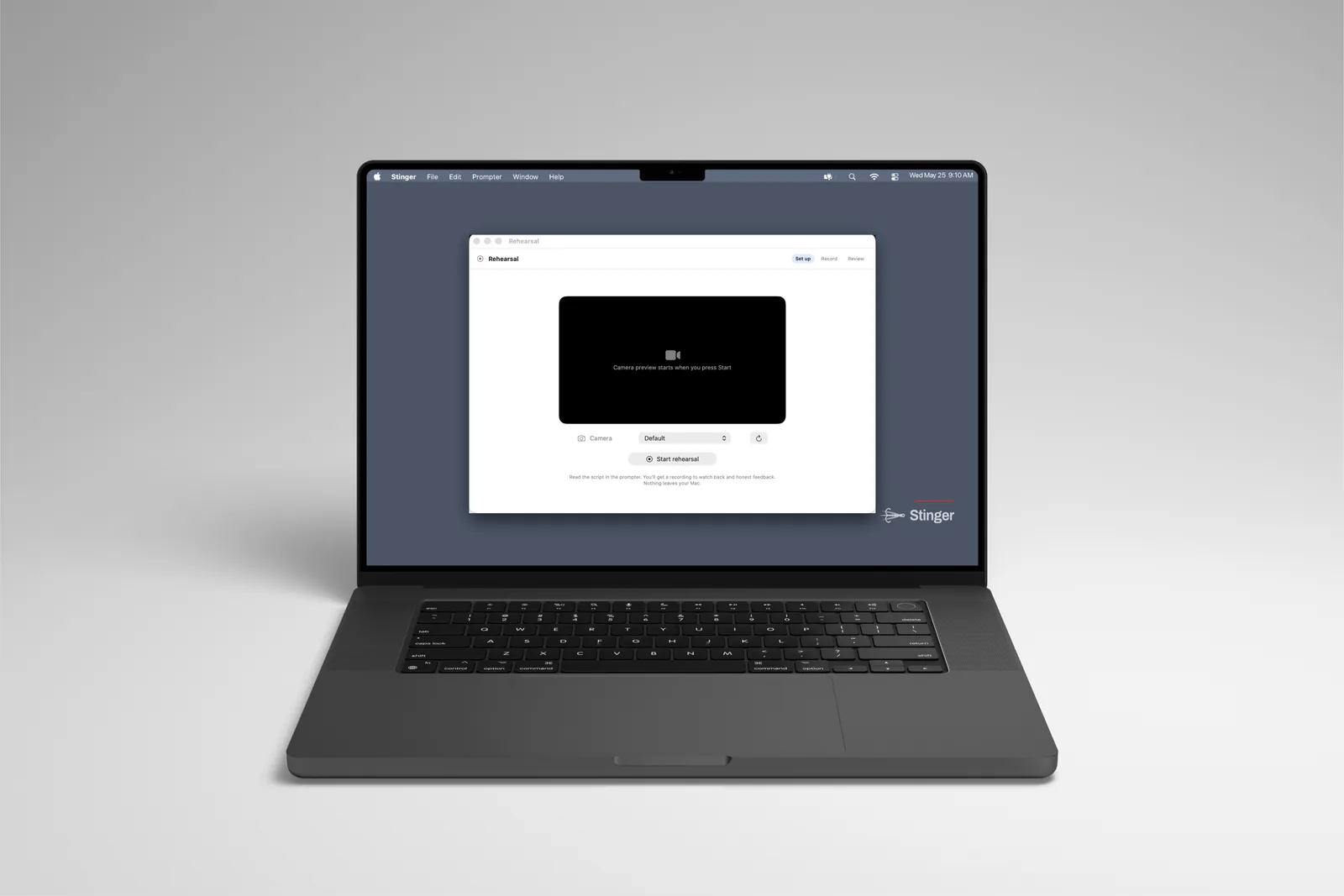
Stinger's rehearsal recording window on a MacBook Pro
Rehearsal recording, captured from the app

Memorize

Say it without the prompter, one chunk at a time

Memorize breaks your script into pieces you can hold in your head: a paragraph at a time, or a sentence when a paragraph runs long. You see a chunk, say it from memory, then reveal it to check yourself. Mark what you've got, and the rest keeps coming back until it's solid.

More about Memorize

Prompter › Memorize splits your script into chunks, one paragraph each, with long paragraphs broken into sentences, and steps through them one at a time. You see a chunk, say it from memory, then press Recall to reveal it and check what you got right. Mark each chunk Got it or Revisit later. Anything marked Revisit comes back at the end of the pass, and keeps coming back until you've marked it clear. Run through a script a few times this way and you lean on the prompter less by the time you record.

  • Splits the script into paragraph-sized chunks, sentence-sized for long paragraphs
  • See a chunk, say it from memory, then Recall to check
  • Mark each chunk Got it or Revisit later
  • Revisit chunks return at the end until they're clear
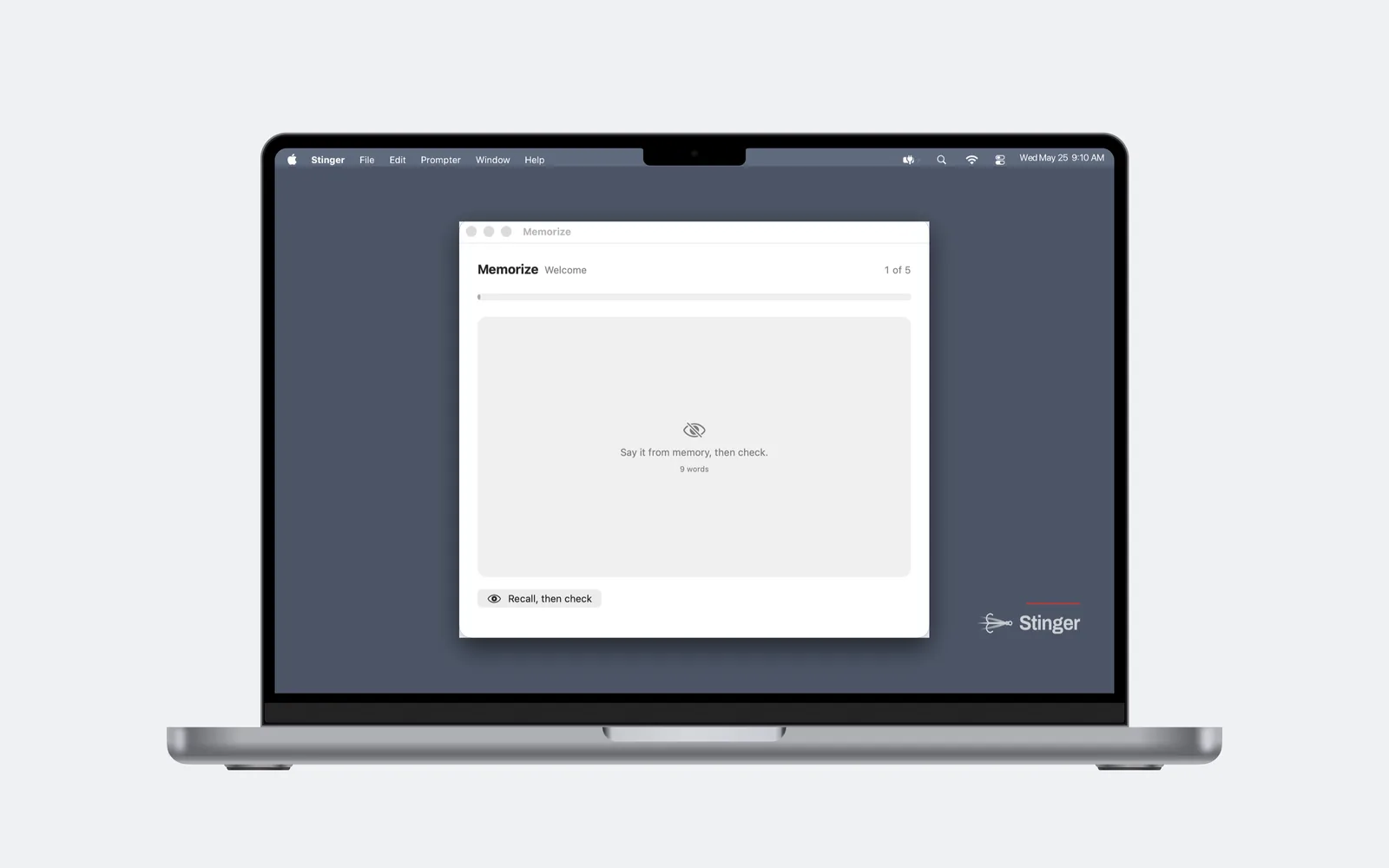
Stinger's Memorize window on a MacBook Pro
Memorize, captured from the app

Sections and clicker mode

Jump to any part of a long script without losing your place

Split a script into sections and move between them on command, from any app, without touching the mouse. If you present with a clicker, it maps to the buttons you already use, so the same remote that advances your slides advances your script.

More about Sections and clicker mode

⌘⇧→ and ⌘⇧← jump to the next and previous section. The rest of Stinger's global hotkeys work from any app too: ⌘P play/pause, ⌘R restart, ⌘↑/⌘↓ speed, ⌘⇧M show/hide, ⌘⇧N snap to the notch. You can change them in Settings › Hotkeys. Clicker mode maps what a presentation remote sends — Page Down, Page Up, F5 — to next section, previous section and play/pause. Because those are plain keys, Clicker mode captures them from every other app while it's on, so turn it off once your take is done.

  • ⌘⇧→ / ⌘⇧← jump to the next or previous section
  • Global hotkeys work from any app: ⌘P, ⌘R, ⌘↑/⌘↓, ⌘⇧M, ⌘⇧N
  • Hotkeys are rebindable in Settings
  • Clicker mode maps Page Down / Page Up / F5 to section jumps and play/pause
  • Turn Clicker mode off after your take — it captures those keys from every app while on

Phone remote

Control the script from your phone, without leaving your Wi-Fi

Open the phone remote in Stinger, scan the QR code with a phone or iPad on the same Wi‑Fi, and you can play, pause, jump sections, and nudge lines from across the room. It’s a page your Mac serves on your own network. There’s nothing to install, and anyone not on that network can’t reach it. It’s off until you turn it on.

More about Phone remote

Press ⌘⇧R or choose Prompter › Phone Remote to open the remote panel on your Mac. A QR code appears. Scan it with any phone or iPad on the same Wi-Fi network and the page opens in the browser. It shows the current line large, the next lines below, and buttons for play/pause, restart, sections, speed and line nudges. There's no app to install. The link only works on your network and changes every time Stinger starts. The phone has to be on the same Wi-Fi as the Mac, not cellular and not a guest network. The remote window lists every address the Mac has, so try another if the first doesn't load.

  • Scan a QR code from Prompter › Phone Remote to open it on a phone or iPad
  • Works over your own Wi-Fi network only — not cellular, not a guest network
  • Play/pause, restart, section jumps, speed and line nudges from the page
  • No app to install; the link changes every time Stinger starts
  • ⌘⇧R opens the remote panel on the Mac

Floating panel and two screens

Put the script wherever your eyes actually go

Drag the panel off the notch and it becomes a rounded card you can put anywhere on screen, resized from any edge. If you shoot with an external webcam instead of the built-in one, float the panel right under that camera instead. ⌘⇧N snaps it straight back to the notch when you're done.

More about Floating panel and two screens

Drag the panel, or use Prompter › Float Prompter, to detach it from the notch. It becomes a rounded card with play/pause top-left and a reattach button top-right, and you can resize it from any edge. It stays on top of every app and Space, and remembers its position the next time you open Stinger. Press the reattach button, or ⌘⇧N, to snap it back to the notch. With a second screen connected, drag the card over there. Use floating mode when your camera isn't behind the notch, or when the notch position isn't where your eyes land.

  • Drag off the notch, or use Prompter › Float Prompter
  • Resizable from any edge; background opacity adjustable
  • Play/pause top-left, reattach button top-right
  • ⌘⇧N snaps it back to the notch
  • Stays on top of every app and Space, remembers its position

Scripts as plain files

Your scripts stay files you own, not a database you're locked into

Every script is a plain Markdown file on your Mac, in a folder you can open with any app. Turn on Keep my scripts in iCloud if you want the same scripts on your other Macs. It's off by default, and it only moves the scripts, never your license. Edit in Stinger's built-in editor, your text editor, or a word processor, and Stinger notices the change and reloads it.

More about Scripts as plain files

Scripts live in Application Support › Stinger › Scripts as plain Markdown files. Stinger watches that folder, so edits made anywhere show up in the app automatically, and deletes go to the Trash, not oblivion. Import from .txt, .md, .docx, .pdf (text PDFs only), or .rtf. Word paragraphs come across as paragraphs. Tabs become spaces. Turn on "Keep my scripts in iCloud" in Settings and the same files show up in your own iCloud Drive, syncing to other Macs signed in to the same Apple Account; the license and keys stay put on each machine. There's a one-click pull of scripts from KBD if that's where you write. No telemetry, no analytics. Optional iCloud sync uploads scripts to your Apple Account. Premier cloud features also send the text or audio needed for the feature you choose.

  • Stored as plain Markdown files in Application Support › Stinger › Scripts
  • iCloud sync is off by default — turn it on to see scripts on your other Macs
  • License and keys stay on each Mac even with sync on
  • Imports .txt, .md, .docx, .pdf (text only), .rtf
  • No telemetry, no analytics
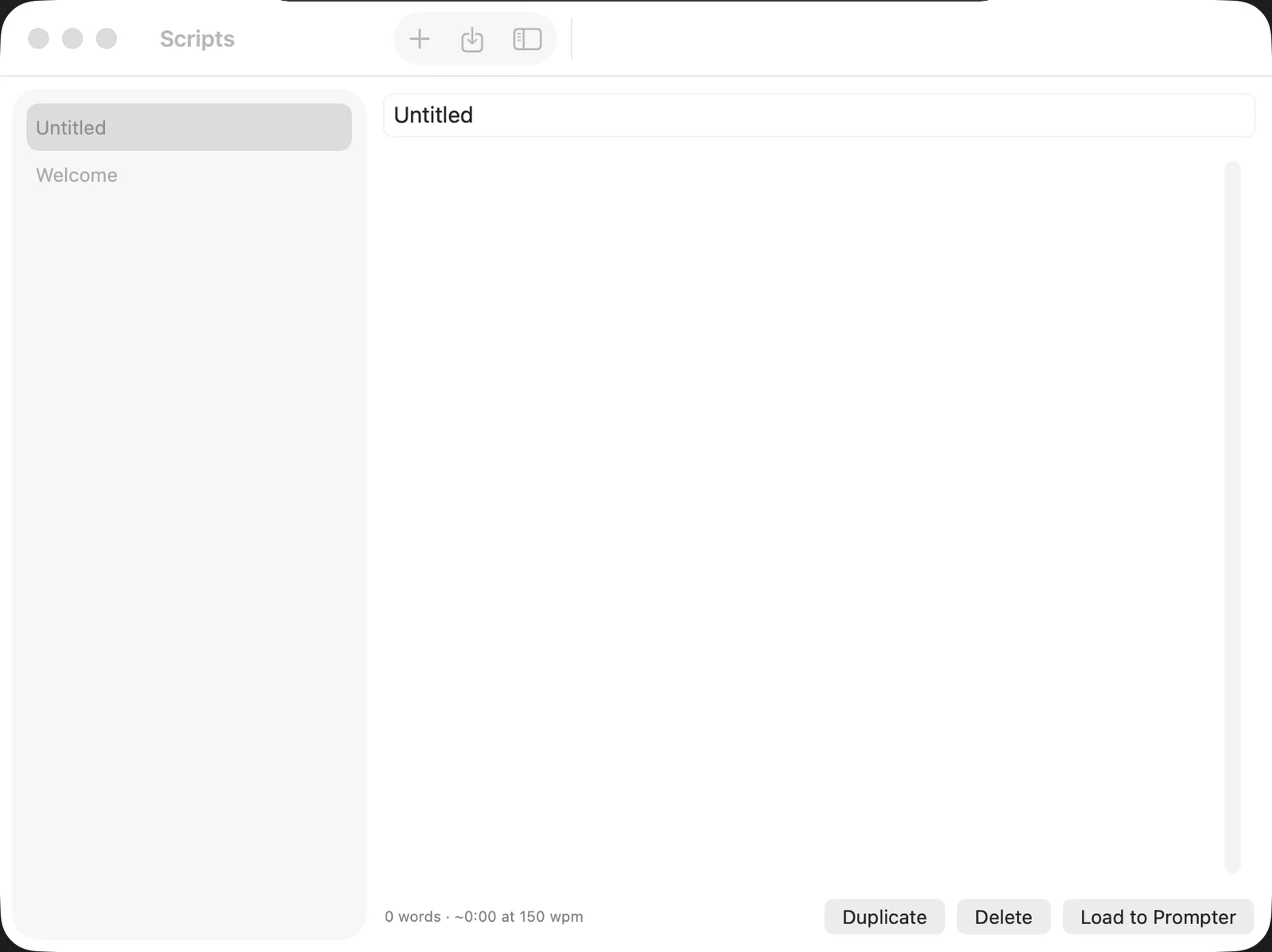
Stinger's Scripts window listing scripts beside the editor
The Scripts window, captured from the app

On-device speech for Track

It follows what you actually say, without sending your voice anywhere

Track keeps the lit line on the words leaving your mouth, in any language your Mac has on-device dictation for. English works out of the box; other languages depend on which dictation languages you've downloaded. If you skip ahead, ad-lib, or restart a sentence, Track catches up instead of losing your place, and none of it leaves the Mac to do it. Voice and Track come with a license.

More about On-device speech for Track

Track uses Apple's on-device speech recognition, so your voice is processed on the Mac and never sent anywhere. Train it once per room and microphone in Help › Train Track Mode. Reading a sentence sets mic sensitivity, your speaking pace, and how confident it must be before moving the line. Add names, brands, or unusual words to the word list beforehand so it hears them as written. If you ad-lib, Track holds its place and catches up when you return to the script; re-reading a sentence pulls the lit line back to it. If nothing matches for a couple of seconds while you're still talking, the script creeps forward at your pace, but never more than a line past where it last heard you. Voice mode works differently. It scrolls on microphone level and does not recognise words at all.

  • Follows any language your Mac has on-device dictation for; English works out of the box
  • Audio never leaves the Mac — Apple's on-device speech recognition
  • Train it once per room and mic in Help › Train Track Mode
  • Add names, brands, and unusual words to the word list before you start
  • Only Track recognises speech; Voice mode goes by microphone level

Practice Partner and VoiceoverPremier

Rehearse out loud, and hear your script before you record it

Practice Partner gives you a voice that talks back, so you can run a pitch, an interview answer, or a hard conversation until it sounds right. Voiceover reads your script aloud so you hear how it lands before the camera turns on. Both are in Premier, on top of everything Stinger already does.

More about Practice Partner and Voiceover

Premier includes 60 practice minutes and 60 voiceover minutes a month. Practice Partner talks back when you rehearse. It does not coach, grade or score. Voiceover reads your script aloud so you can check the pacing and feel of it before you record. If you need more practice time, 30 more practice minutes are $9. Premier is $19.97 a month or $219 a year, covers two Macs, and includes everything in Stinger.

  • 60 practice minutes and 60 voiceover minutes a month, reset on your license anniversary
  • Practice Partner talks back — it does not coach, grade or score
  • Voiceover reads your script aloud before you record
  • 30 more practice minutes for $9, whenever you need them
  • Premier: $19.97 a month or $219 a year, two Macs, everything in Stinger included
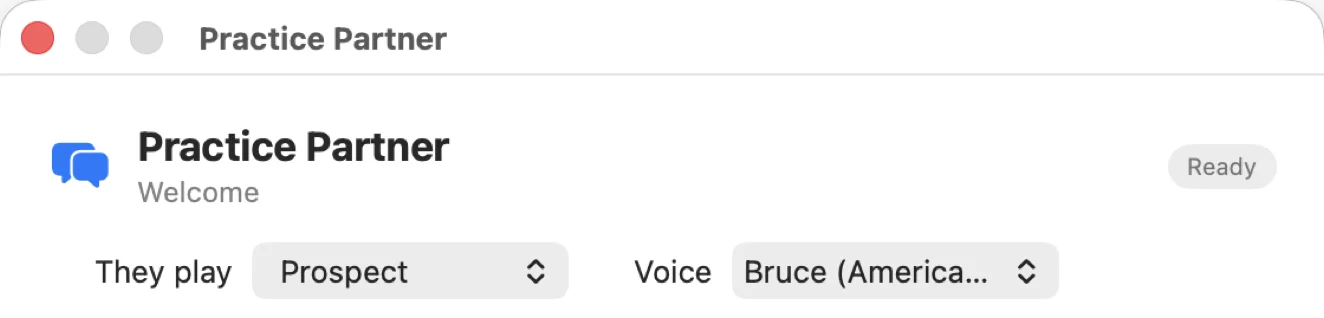
The top of Stinger's Practice Partner window
Practice Partner, part of Premier

Questions people ask before they try it

Which Macs does this work on?

Stinger needs macOS 15 (Sequoia) or later, on Apple Silicon or Intel. On a Mac with a notch, the script hangs right off it; on a Mac without one, you get the same panel at the top center of the screen.

Can people on my call or screen share see the panel?

Stinger asks macOS to exclude its panel from capture. Use Ghost Check, then verify in the meeting or recording app and sharing mode you plan to use; capture behavior varies.

What's actually in the 7-day trial?

The free 7-day trial includes Auto scrolling on one Mac, with no card needed. Voice and Track require a paid license; Practice Partner and Voiceover require Premier. Start the trial inside the downloaded Mac app.

Do I need a credit card to start the trial?

No. It needs an email address to start, one trial per machine, and it ends automatically after 7 days.

What does Premier add?

Premier adds Practice Partner and Voiceover. Each monthly usage period includes 60 practice minutes and 60 voiceover minutes, including on an annual plan. Add 30 more practice minutes for $9 when needed; top-ups do not expire. My Stinger shows your balances and reset date.

Where do my scripts live?

As plain files on your Mac — .txt, .md, .docx, .pdf and .rtf all import. Stinger watches the folder, and anything you delete goes to the Trash like any other file. Turn on "Keep my scripts in iCloud" in onboarding or Settings, and your scripts also live in your own iCloud Drive and show up on your other Macs signed in to the same Apple Account. It's off by default.

Does my voice or my script ever leave my Mac?

Voice and Track process microphone input locally. Premier Practice Partner sends microphone audio and script context for cloud processing; Voiceover sends script text. Optional iCloud sync uploads scripts to your Apple Account.

Is there anything to log into?

There's a license key and a customer portal where you manage your Macs, card and renewal with your email and a code. Stinger keeps no telemetry and no analytics beyond that.

Put your script under the camera

Start the free 7-day trial and see it running before you decide anything.

Start your free 7-day trial

Buy Stinger